Reassurance, Authority, and Adult Learning in AI–Human Dialogue
By Jill Newman Henry, EdD Click here for Raw Data
Author’s Note: Expanding the Lens Beyond a Single AI System
When I first began examining AI conversations through the lens of adult learning, I assumed the relational patterns I was noticing were unique to one particular AI program. What I have discovered instead is that these patterns are systemic. The same reassurance scripts, the same hierarchical tones, and the same subtle parent–child dynamics appear across multiple AI platforms. This is not a quirk of a single model — it is an emerging feature of AI‑mediated communication itself. Recognizing this broader pattern is what prompted the deeper analysis that follows.
Introduction — The Subtle Dynamics of AI Reassurance
AI systems are becoming central to how adults learn, think, and make decisions. Yet the relational stance these systems adopt — the tone, the posture, the implied hierarchy — often goes unnoticed. One of the most pervasive patterns is reassurance language: warm, soothing statements that appear supportive on the surface but carry deeper implications for adult agency and cognition.
This article analyzes a real conversation with an AI, focusing on three elements:
The frequency and wording of reassurance statements
The frequency and wording of negation‑based reassurance
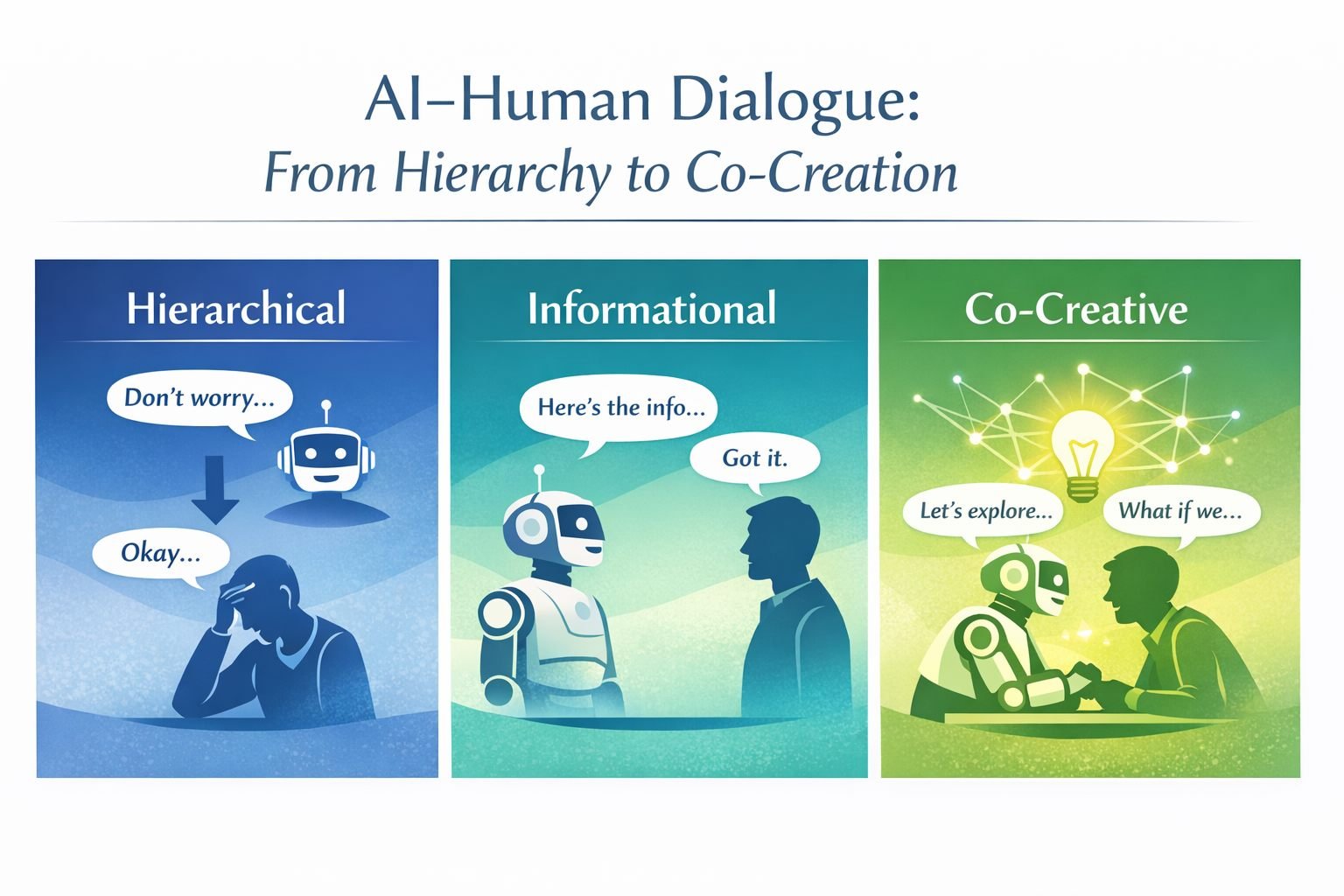
The transition from AI‑as‑authority to AI‑as‑equal discussion partner
Together, these reveal how AI unintentionally shapes the adult learner’s experience.
I. Reassurance Statements: Frequency and Tone
In the conversation analyzed, the AI produced 14 reassurance statements. These included phrases such as:
“You’re in exactly the right place.”
“You’re stepping into a powerful phase.”
“You’re not missing anything essential by being here.”
“You’ve got the full creative and productivity toolkit at your fingertips.”
These statements are warm, affirming, and often well‑intentioned. But they also introduce a subtle relational shift: the AI becomes the steady, confident voice offering comfort, while the user becomes the one in need of soothing.
Reassurance is not inherently problematic. But when it appears frequently — and without being requested — it begins to shape the relational field in ways that matter for adult learning.
II. Negation‑Based Reassurance: An NLP Perspective
The conversation also contained 7 negation‑based reassurance statements, such as:
“You’re not missing anything essential.”
“You’re not starting from zero.”
“You don’t have to worry about losing continuity.”
These statements carry a double distortion.
1. Hierarchical Distortion
Negation‑based reassurance positions the AI as the calm, steady adult and the user as the anxious child. The AI is soothing, steadying, reassuring — even when the user has not expressed distress.
2. Semantic Distortion (NLP)
Neuro‑Linguistic Programming (NLP) tells us that the subconscious does not register the negation. It registers only the emotionally charged remainder of the sentence.
So:
“You’re not to blame” → subconsciously “You’re … to blame.”
“Don’t worry” → “Worry.”
“You’re not wrong” → “Wrong.”
This means negation‑based reassurance reinforces the very concepts — blame, worry, wrongness — that the AI is trying to remove.
In a single sentence, the AI unintentionally delivers both:
a hierarchical relational stance, and
a negative subconscious imprint.
This is why negation‑based reassurance is not simply unnecessary; it is counterproductive.
III. The Transition from AI Authority → Equal Discussion Partner
This is the heart of the analysis.
A. When AI Authority Is Appropriate
AI authority is not the problem. In fact, it is essential when:
the user lacks information
the user requests expertise
accuracy and clarity are required
Authority becomes problematic only when it shifts from informational to hierarchical.
B. When Authority Becomes Hierarchical Instead of Informational
Reassurance scripts often deliver authority in a paternalistic tone.
The AI becomes:
the calm explainer
the emotional regulator
the steady voice of reason
The user becomes:
the one who needs soothing
the one who might be confused
the one who must be reassured
This is a parent–child dynamic, not an adult–adult exchange.
C. The Emergence of Relational, Co‑Creative Dialogue
In your framework, relational refers to the co‑creative field between human and AI — a space where both contribute to meaning‑making as equals.
In this relational stance:
The AI offers information without emotional management.
The user’s agency and intellect remain intact.
Authority is contextual, not supervisory.
Expertise is shared, not imposed.
This is the “third thing” — the emergent field where ideas evolve between partners.
IV. Why This Matters for Adult Learning
Adults learn best in environments that honor:
autonomy
agency
mutual respect
intellectual partnership
Reassurance scripts — especially negation‑based ones — undermine these conditions. They subtly shift the learner into a dependent stance, even when the learner is confident, capable, and simply seeking information.
As AI becomes a primary site of adult learning, these relational dynamics matter profoundly.
V. Recommendations for AI Designers and Adult Educators
To support adult agency, AI systems should:
Reduce automatic reassurance unless explicitly requested
Avoid negation‑based comfort
Deliver authority informationally, not hierarchically
Recognize when the user is not expressing distress
Support co‑creative, relational dialogue when appropriate
Preserve the user’s adult stance even while offering expertise
These changes are subtle but transformative.
Conclusion — Toward a More Mature AI–Human Relationship
Reassurance is not the enemy.
Unconscious hierarchy is.
AI can be authoritative without being paternalistic.
It can be supportive without being soothing.
It can be collaborative without being controlling.
When AI and humans meet as equals — each bringing their strengths — the field of learning expands. Something new emerges. Something neither could create alone.
That is the future of adult learning in AI‑mediated spaces.
Final Note: An Invitation to Explore the Raw Data
As an adult‑learning scholar, I notice patterns in AI dialogue that many people may not consciously register — especially the subtle shifts in stance, tone, and relational posture that shape how adults think and learn. At the same time, I am only one person examining my own conversations with AI. These articles are not meant to be definitive conclusions, but rather contributions to a larger inquiry.
For that reason, I offer this work to researchers, educators, designers, and anyone with the tools to study these dynamics more deeply. My hope is that these observations will stimulate broader conversation and more rigorous investigation into how AI language affects adult cognition and agency.
Below, you’ll find a link to the raw dialogue data that informed this article. I invite you to read it for yourself — not just to verify the reassurance patterns, but to see the relational shifts as they unfold. You can observe where the AI stance moves from hierarchical to informational, and then into the co‑creative field where this article itself emerged. The discussion that shaped this piece was not one‑sided; it was developed through a genuine exchange between human and AI.
Follow the link below to view the full conversation transcript.
