The Way of Flow
A way to move through life more gently.
Life brings change, uncertainty, possibility, and days when everything seems to require more effort than it should. Sometimes the pressure comes from a difficult situation. Sometimes it comes from something we deeply want—a new direction, meaningful work, a different way of living. And sometimes we notice that the conversation has ended, but we are still having it in our heads.
Our bodies participate in all of this. We tighten, brace, and get ready to respond. Our thoughts circle. We try harder to find an answer. Before long, we are dealing with what is happening and everything we have added around it.
The Way of Flow explores how we can meet these experiences with greater awareness and less unnecessary struggle. It is a map I use in my own life, developed through years of studying transformation, teaching, working with energy, and discovering that knowing something and living it can be two rather different experiences.
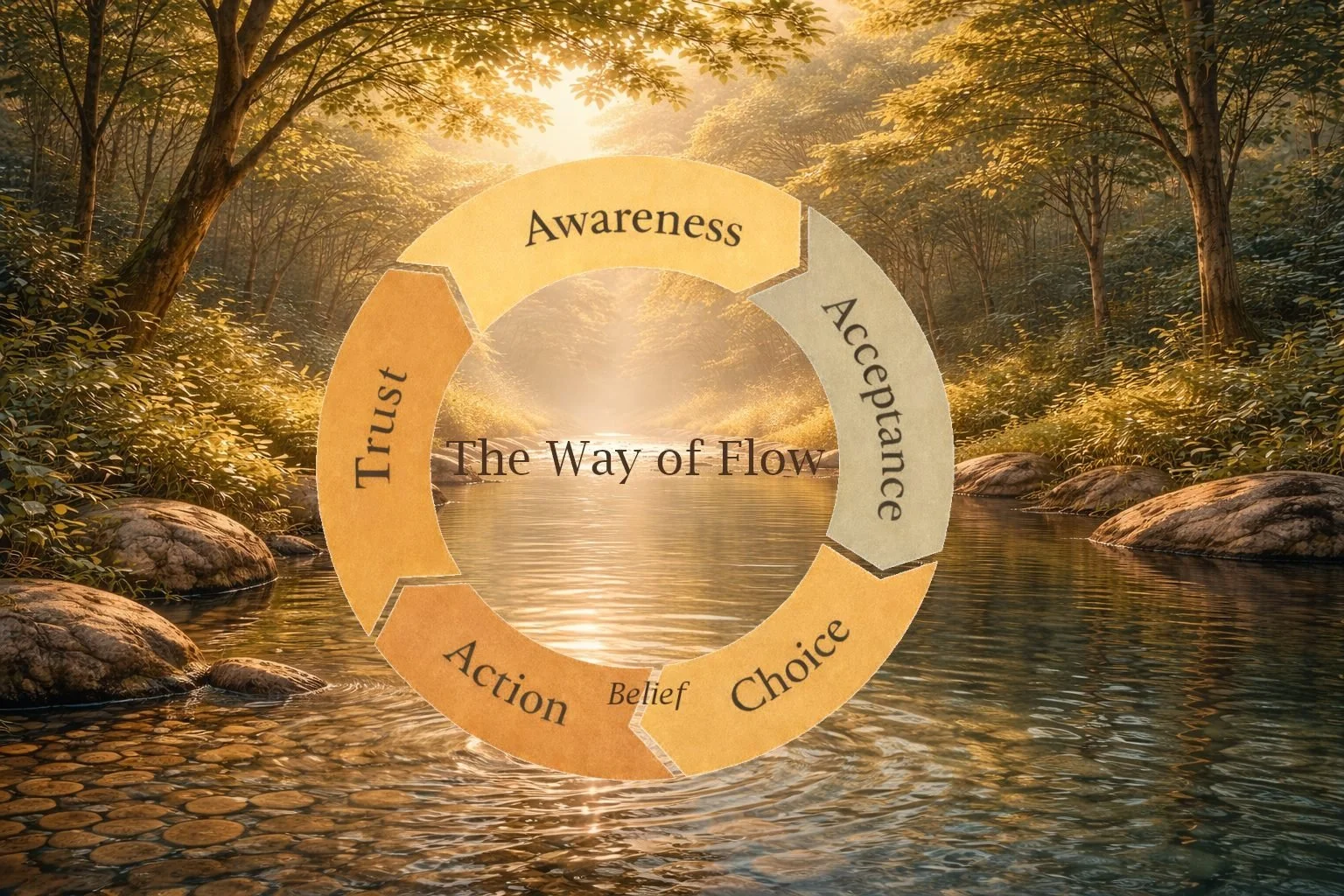
I return to five movements: Awareness, Acceptance, Choice, Action, and Trust.
Awareness begins with noticing. What is happening in my body, my thoughts, my emotions, and the exchange between us? What is the quality of my energy? We can recognize a reaction even while we are still caught up in it. That noticing gives us somewhere to begin.
Acceptance allows us to acknowledge what has occurred and become curious. “Ouch. That pushed my button. Isn’t that interesting?” Here begins the treasure hunt: exploring what the reaction touched, what belief it stirred, and what we were trying to protect. The treasure is the possibilities that become visible through that exploration.
Choice asks us to look at the perspective we are choosing from. Our beliefs about how life works shape what we think is possible. As that view widens, we may discover options beyond defending, fixing, or trying to make someone else change. We begin to recognize what is ours to choose.
Action gives that choice a place in daily life. We make a commitment and find a practical way to live it. A pause, a conversation, a boundary, a request for support, or a familiar practice may help us move in the direction we intend. Sometimes our choice is to let an experience rest and take no further action.
Trust opens a conversation between our desires, our intentions, and the deeper wisdom within us. We do what we can see to do, listen for what comes next, and allow room for a path we have not yet imagined. What arrives gives us new experience, and Awareness begins again.
These movements form a spiral. We return to them with a little more understanding, sometimes while life is unfolding and sometimes afterward, when we finally have room to hear ourselves.
Through all five runs a simple question: How do I do this gently?
A gentle day can contain firm decisions, disappointment, ambition, and change. Gentleness is in how we meet those experiences and how we treat ourselves along the way. It might be the tone of a reply, the willingness to pause, or the discovery that we don’t have to solve tomorrow this afternoon.
Each of the following pages explores one movement and offers a brief practice to try. Begin with the one that draws your attention, or follow them through and see what you discover.
Feel the flow. And have a gentle day.
Most of us recognize when something in life has moved out of flow. Sometimes the problem is obvious. Sometimes there is only a sense that we are working too hard, reacting more quickly, or finding ourselves in a familiar situation once again.
The usual response is to try harder. We think it through one more time, make another plan, or tell ourselves what we ought to do differently. Occasionally that works. Often it adds another layer of effort to something that is already difficult.
The question is usually practical: What can I do to help me get where I want to be?
The Way of Flow grew from that question, although the answer turned out to be less about what to do and more about understanding how change actually happens.
Imagine placing one aspect of life on the table between us. It may involve work, health, a relationship, a decision, or a pattern that keeps returning. We are not going to assume that it is a problem to fix. We are going to become curious about what is happening, how it is being experienced, and what it may be asking us to notice.
Transformation is not a matter of fixing what is wrong with us. It is a process of returning to alignment—of noticing where energy, attention, belief, and action have moved out of relationship with one another. When that relationship begins to change, new possibilities become available.
The Way of Flow describes this process through five movements:
Awareness. Acceptance. Choice. Action. Trust.
These are not steps to complete correctly. They are shifts in our relationship with what is happening. Awareness helps us see what is actually present. Acceptance receives what has been revealed and allows it to be there. Choice opens the possibility of a different response. Action gives that choice a place in lived experience. Trust keeps us in relationship with the process, even when life does not unfold as expected.
The movements do not promise a particular outcome. Sometimes change begins quietly—with a sensation, an uncomfortable recognition, or the realization that an old belief no longer fits. Sometimes it becomes visible through a different choice or a small action taken in daily life.
And sometimes we act from the clearest place available to us and everything still goes sideways.
That, too, is part of the Way of Flow. Trust does not mean believing that life will give us the outcome we wanted. It means trusting that the process remains available—that whatever comes next can be met again through Awareness, Acceptance, Choice, and Action.
Flow is our natural state. We do not have to manufacture it. We learn to recognize what has interrupted it—and how to return.
A quick index for finding your way in the Flow