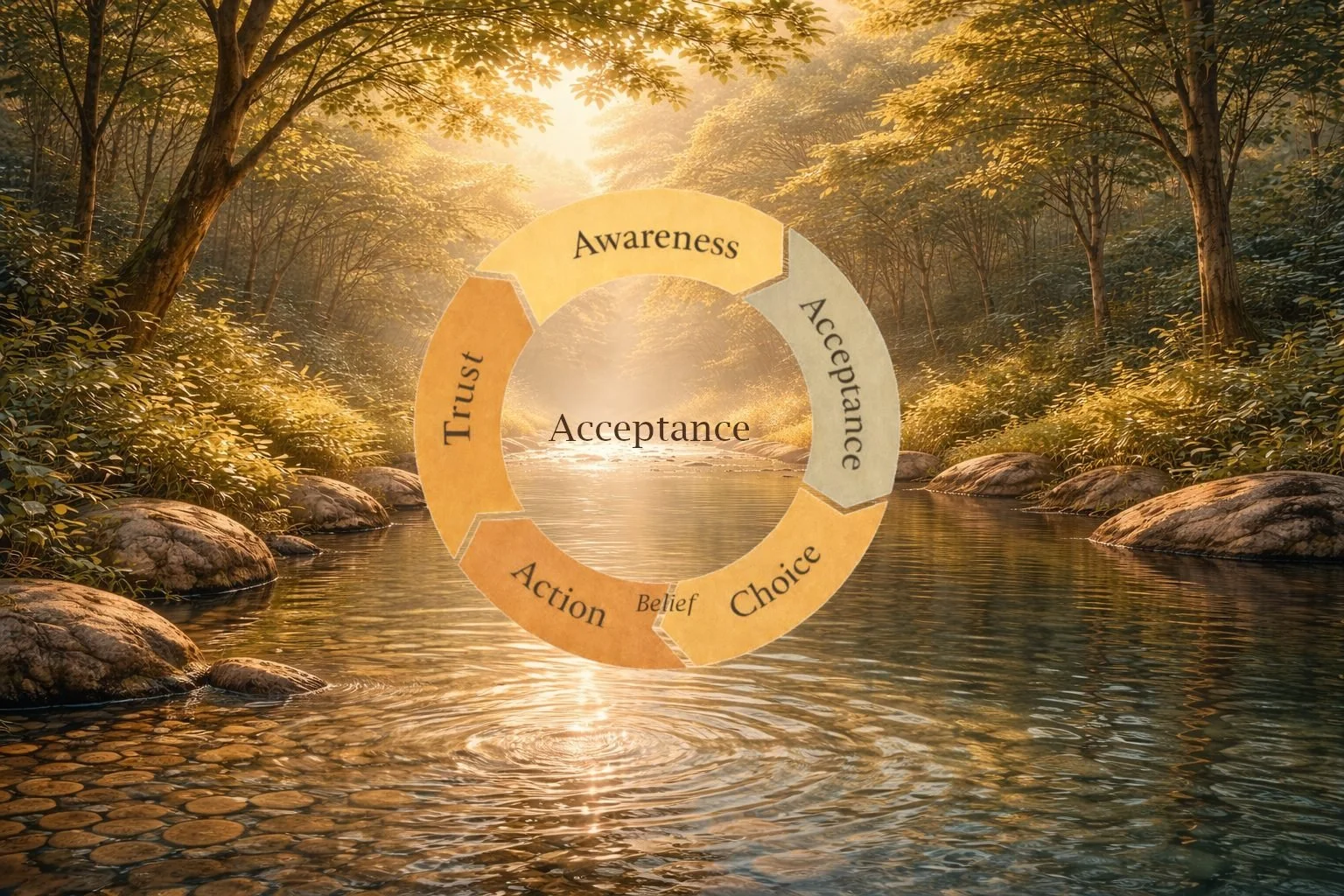
Acceptance
This is what happened. What might it reveal?
A friend and I had a conversation that became a contest over who was right. She was insistent about what I should do, and I became equally insistent about why my way was better. I could feel myself tighten. I knew I could stop pushing, and I didn’t want to.
Afterward, the conversation was over, but there was every opportunity to keep it going in my mind. I could explain myself again, imagine a better reply, or wonder whether I ought to send a message to make everything okay. None of that would change the conversation we had already had.
Acceptance begins there. She said what she said. I said what I said. This occurred. I can acknowledge it and let it belong to the past. From here, I have something to explore.
There is a friend I talk with over a distance. He tells me his problems, and I tell him mine, and our response to each other is often, “Oh, how marvelous! Look at all that information you now have to work with.”
That little exchange changes the atmosphere. There is room to look at what happened with some curiosity and even humor. The conversation that bothered me has given me a clue. I can become grateful for what it might help me discover.
This is where the treasure hunt begins.
What Pushed My Button?
If my friend had said the sky was green and I thought it was blue, I wouldn’t have needed to fight about it. These particular words touched something. I felt a need to defend my perspective, and beneath that insistence I sensed fear. Something in me was responding to more than a difference of opinion.
“Ouch. That’s interesting. That pushed my button.”
That question—what did this touch in me?—can take us beneath the familiar account of what someone else said or did. Perhaps a comment carries the meaning that we are incapable, that our judgment cannot be trusted, or that a possibility important to us is being dismissed. The words themselves may be brief. What they awaken can have a much longer history.
In my work, I understand many of these reactions as clues to beliefs and patterns held beneath conscious awareness. Some developed around experiences we remember. Others have become so familiar that they simply feel like the way life is. The hunt gives us a chance to notice them.
We can follow a word, a feeling, a memory, or an association. What am I afraid might be true? What was I trying so hard to protect? Where have I felt this before? There is no need to produce an answer immediately. Sometimes a question needs room before anything useful appears.
The treasure is the choices that become visible through this exploration. As I understand more about what my reaction is protecting, possibilities begin to emerge that I couldn’t see while I was busy defending myself.
Meeting What We Find Gently
Gentleness matters here because an inquiry can easily become another interrogation. “Why did I do that?” can carry curiosity, or it can sound like a prosecutor demanding an explanation. The words may be almost identical. The way we meet ourselves is different.
I can acknowledge that I wanted to be right. I can recognize that there was some pleasure in pushing back. I can also recognize that I was defending something important to me. All of that belongs in the exploration.
Self-responsibility begins with this willingness to look at my own participation. “You made me” leaves my attention fixed on the other person. “That pushed my button” gives me somewhere within myself to look. I still have choices about the relationship and how I wish to be spoken to. Understanding my reaction helps me see those choices more clearly.
Sometimes I can look upon another person with compassion and allow their view to remain theirs. At other times, I can see that I don’t have the capacity to stay in that exchange without taking it in or pushing back. Recognizing that honestly may lead to a boundary. Acceptance includes acknowledging where I actually am.
It also includes the conversation inside my own head. “I’d better explain myself. I’d better make sure she isn’t mad.” That urgency is information too. What makes it so difficult to leave the encounter alone for a while? What do I imagine will happen if I don’t immediately make it better?
These questions give the treasure hunt somewhere to go. An urge can be felt and explored before it becomes an action.
Talking things through with someone can help. There is something valuable about having another person listen while the pieces begin to arrange themselves. My friend’s “How marvelous!” reminds me that there is more to discover than my first account of the problem.
Looking back at my own conversation, I found something I hadn’t considered in the moment: I wasn’t gentle with myself because she wasn’t being gentle with me, and therefore I wasn’t gentle with her. Gentleness had disappeared from the exchange. Seeing that introduced a possibility I hadn’t been using.
What might become available if I stayed gentle with myself?
Now there is room for Choice.
A Little Lightness
I once created an image for a reflection called “Oh, for the glory of it all!” A woman sits beneath an umbrella in a boat amid waves and commotion, apparently delighted to be there. The image makes me smile. It carries something of the spirit my friend and I bring to our conversations: here is life, and here we are in the middle of it.
Sometimes acceptance has that quality. We can look at our very human predicament and find a little room around it. “Well, look at that. What have I got to work with?”

A Moment to Explore
Bring to mind a recent, manageable moment that stayed with you—a conversation, a disappointment, or something you said to yourself. Begin with what occurred: “This happened. This was my reaction.”
Then try, “That’s interesting. What did this touch in me?” Notice any word, feeling, memory, or belief that comes forward. Let it be a clue without needing it to explain everything.
Ask gently, “What was I trying to protect? What possibility might I be overlooking?” There is no need to decide what to do yet. Give yourself room to discover.
A quick index for finding your way in the Flow