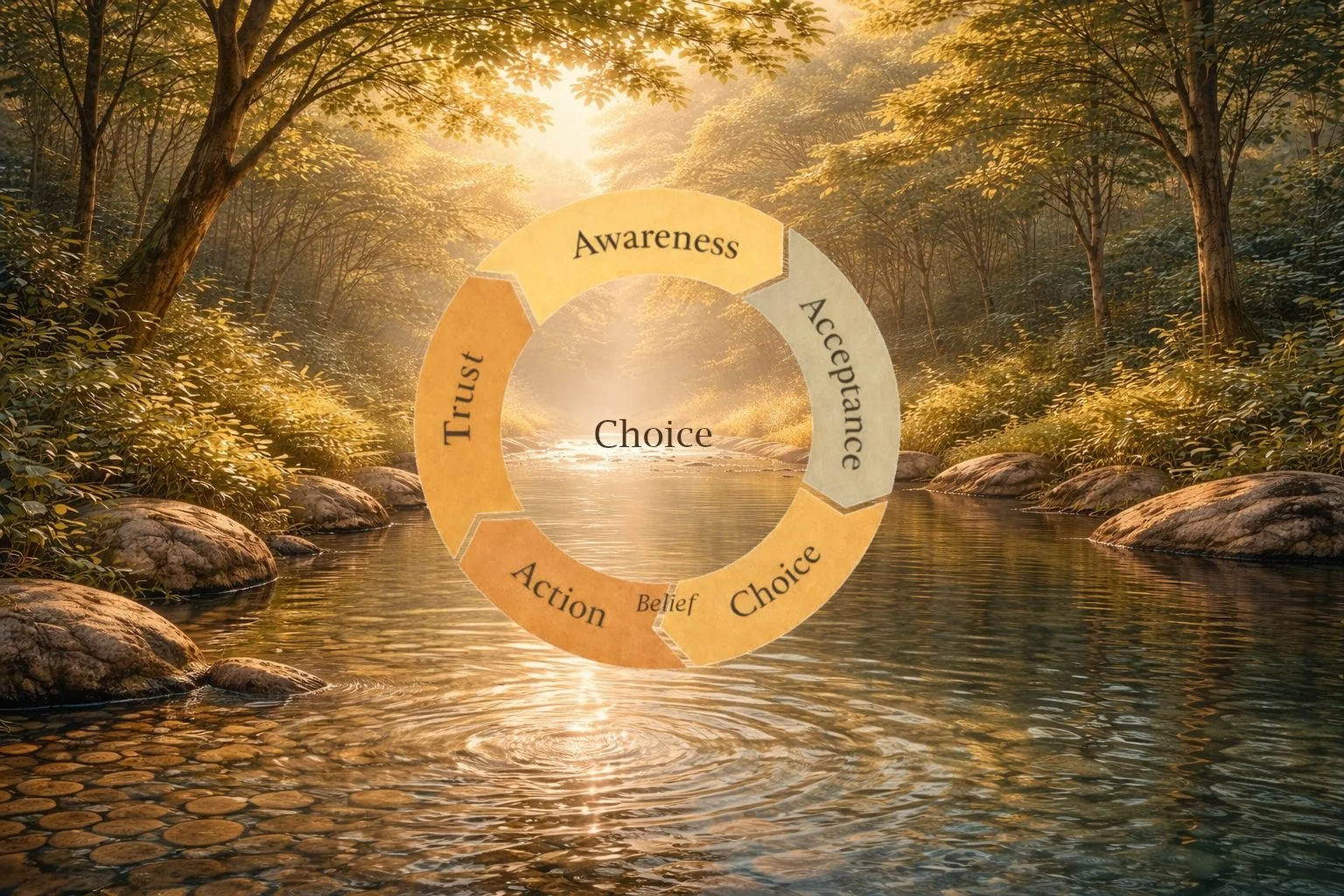
Choice
Discovering what is possible from here.
After a conversation with a friend became an argument over who was right, I found myself looking at what had happened within me. I had tightened, pushed back, and wanted her to understand that my way of seeing things was better. Once I could let the conversation belong to the past, I became curious about why it had touched me so strongly.
That exploration—the treasure hunt—began to reveal choices. I could stop interacting with her. I could meet her with gentleness and become curious about what was stimulating her concern. I could continue exploring what her words had stirred in me. I could also take no further action about the conversation. No explanatory text. No attempt to make everything better. I could let what I had discovered settle and see what happened the next time we met.
While we were arguing, the possibilities had seemed much narrower: convince her, defend myself, or give in. Now there was more room.
Choice in the Way of Flow begins with that opening. Sometimes the first choice is simply a willingness to consider that another way exists. We may still be discovering what it is.
The Beliefs Behind Our Choices
Our choices arise within our understanding of how life works. That understanding is a paradigm—the lens through which we interpret experience, make meaning, and decide what seems possible.
If I believe that disagreement threatens my ability to follow my own path, I may feel compelled to defend every decision. If I believe that someone else can disagree while I remain free to choose, a different response becomes available. The conversation may be much the same. What I understand to be at stake has changed.
Some beliefs concern a particular situation. Others reach into our whole relationship with life. Am I on my own, needing to protect myself from whatever comes next? Am I part of something larger, able to participate, receive support, and learn as I go? Does safety depend on controlling the outcome? Can I find steadiness while the outcome is still unfolding?
These are questions worth spending time with. A belief can be so familiar that we don’t recognize it as a belief. It feels like a fact, and our choices arrange themselves around it.
This is why the treasure hunt matters. It brings those assumptions into view. Once I can see what I have been choosing from, I can ask whether that understanding still fits—and what another perspective might make possible.
From Circling to Spiraling
In my work on development and learning for transformation, I explored changing paradigms and the movement among doing, thinking, and being. I return to those ideas because I recognize how easily I can keep trying to solve something from within the very view that keeps it going.
I can think of a better argument. I can prepare a more convincing explanation. I can rehearse the conversation until I have won it several times in my own kitchen. But if the question remains “How do I make her see that I’m right?” I am still circling.
The spiral opens as the view widens. I begin to notice the whole exchange, my participation in it, and the importance I have given to winning. I can ask how I want to be in this relationship. Gentleness enters as a possibility. So does a boundary. So does allowing a difference to remain unresolved.
Thinking has helped me recognize the pattern. A different way of being allows me to meet it differently. From there, I can return to practical questions about what to do.
What Is Mine to Choose?
People often come to me wanting to know how to make someone else change. I recognize that wish. Life would be so much easier if the other person would just understand.
Self-responsibility brings the inquiry home. What am I contributing to this exchange? What am I willing to continue? What do I intend to change in my own participation?
A gentleman once came into my store looking for a kit to perform a banishing spell. As we talked, we explored his energy and what it might take for him to let the relationship end. Another possibility emerged: to be able to say with compassion that the relationship was finished, and then move on in his own life. He left with a singing bowl to support his own practice.
I found myself hearing that conversation in relation to my own. I had been trying to change my friend’s perspective. Yet the choices available to me concerned how I would meet her, what I would take into myself, and when I might step away.
There is something freeing about finding a choice that is actually ours to make.
Feeling Into the Possibilities
As choices emerge, we can notice how each one feels. Does the thought of sending that message bring clarity, or does it start another round of explanations? Does a boundary feel honest? Is gentleness available now, or do I need some space before another conversation?
A choice may feel unfamiliar or uncomfortable and still be one we want to make. We can give it time, consider its likely effects, and notice whether it supports the way we intend to live.
The choices may also work together. I can explore my reaction, choose a boundary, and allow myself to stop revisiting the argument. I can remain open to the relationship without making its repair an immediate assignment.
For me, “How do I do this gently?” introduces something concrete. I can imagine a tone of voice, a shorter reply, a pause. I can imagine treating myself with care while allowing another person to have a different view.
From that wider range of possibilities, an intention begins to form. This is what I want to change in my response. This is what I am willing to practice. Choice is beginning to find its expression in Action.
A Moment to Consider
Choose a manageable situation that has been occupying your attention. Write down the options you currently see, including leaving it alone for now.
Then ask, “What am I assuming about how this has to work?” Perhaps there is an insistence that someone must agree, that everything must be settled immediately, or that there is only one acceptable outcome. Consider what other choice might appear if that assumption loosened a little.
Read your possibilities again. What is yours to choose? Which one supports the way you want to meet this situation?
Finish with a simple intention: “What I intend to change in my own response is…”
Let it be something you can approach gently.
A quick index for finding your way in the Flow