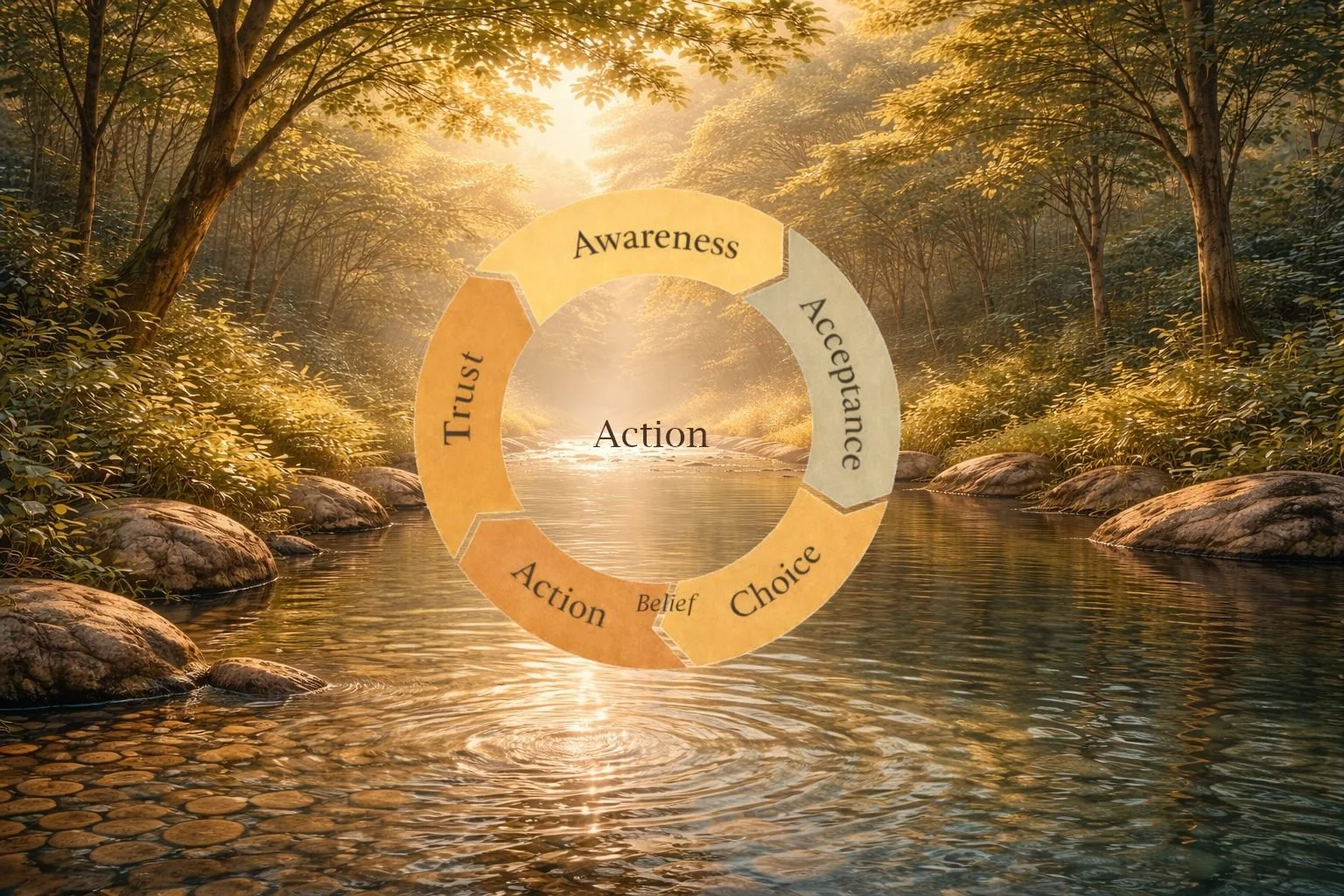
Action
Living what we have chosen.
After an insistent conversation with a friend, I could see several ways to respond. I could explain myself again, limit our conversations, approach her with more curiosity, or let the encounter rest. Exploring my reaction had brought something else into view: I wanted to meet these moments with greater gentleness toward myself.
But what would that look like in an actual conversation? I know how to push back. I have had considerable practice. Gentleness needs an expression I can recognize while I am living it.
That is where Action begins. We take what we have discovered and chosen into daily life. An intention becomes something we practice—in the way we speak, the support we seek, the pause we allow, or the next step we take.
When the Urge Comes First
An urge to act can arrive long before we have made a choice. “I’d better text her. I’d better explain myself. I’d better make sure she isn’t mad.” It sounds practical, even responsible. Meanwhile, the same argument may still be running inside us.
Awareness helps us notice that urgency. Acceptance gives us room to acknowledge what happened. The treasure hunt reveals what is stirring beneath it, and Choice lets us consider our possibilities and the beliefs behind them. Then we can ask what action expresses the direction we actually want to take.
The outward action might be the same. I could send a message because I cannot tolerate leaving anything unresolved, or I could send one because I have something clear and useful to say. It helps to notice what I am asking the message to accomplish. Am I communicating something, or am I hoping to manage the other person’s feelings so I can finally settle?
Sometimes a message is needed. Sometimes it can wait. Sometimes, after a little space, there is very little left to explain.
Doing What Is Mine to Do
Self-responsibility becomes practical here. I can decide how I will participate in the next conversation. I can listen, state my preference, change the subject, or end the exchange. My friend may continue to see things differently. I can practice my choice while allowing that difference to exist.
If gentleness is my intention, I might notice the first tightening and give myself a moment before answering. I might say, “Thank you for being concerned. I’m going to make this decision in my own way.” If I find myself becoming more insistent, I can bring the conversation to a close and give myself room to process it afterward.
Those are actions I can recognize. They give gentleness a shape.
There is also the conversation I have with myself. If I leave an encounter and begin with “You should have known better,” I can notice that I am continuing the pressure. A gentler response might be, “Well, that got lively. What do I need now?” Perhaps I need quiet. Perhaps I need to talk it through with someone. Perhaps I need to eat lunch and stop conducting the entire discussion again in my head.
Allowing the Body to Participate
Action includes the ordinary things that help us become available to a different response. We can let the body settle, move around, listen to music, sit quietly, or use a familiar practice that helps us return to ourselves. The gentleman who came into my store wanting to banish someone left with a singing bowl for his own practice. It gave him something he could do as he learned to let the relationship go.
Different people will find different supports. What matters is whether the practice helps us live the choice we have made. If I intend to meet a conversation gently, tending my own energy beforehand may be part of that intention. So may arranging support for afterward.
In “Flow returns when…,” one of the reminders is that emotion can be felt without having to run the show. That becomes very practical here. I may still feel irritation and choose to speak more slowly. I may feel the urge to explain and allow myself to wait. There is room for the feeling and for the response I am learning to make.
Small actions give us experience with another possibility. We begin to discover what it is like to leave a difference unresolved, ask for help, or hold a boundary without continuing the fight.
Choosing No Further Action
One of the possibilities in my own story was absolutely no further action about the encounter. I could stop trying to make it better. The conversation had occurred, and I had gained some insight. I could leave it there.
That is a choice we can make deliberately. It may involve allowing an explanatory message to remain unsent, returning attention to the present, or noticing that the mind has resumed its rehearsal and gently stepping away again.
There may be a practical matter that still needs attention. We can attend to it. But the mind’s insistence that everything must feel settled immediately does not have to determine our next move.
Sometimes letting an experience rest is the very change we are practicing.
Giving Intention a Place in Daily Life
A written commitment helps bring a choice into focus. “I will be gentler” names a direction. Adding when and how gives us something to work with: “When I notice myself becoming insistent, I intend to pause before answering. If I need space, I will end the conversation pleasantly and return to it later if there is a reason to.”
We can also name what will support that commitment. A reminder where we will see it, a few quiet minutes, a conversation with someone who understands, or a practice we already enjoy can help us remember what we chose.
And we will learn from trying. Perhaps the pause helps. Perhaps we notice the tightening only afterward. That gives us more information. The commitment remains something we can return to and refine as we discover how to live it.
Once I have done what is mine to do, there comes a point when I can loosen my grip on what happens next. I have chosen a direction and begun to practice it. I can allow the experience to unfold.
That is where Action opens into Trust.
A Moment to Put Into Practice
Return to an intention you have chosen. Ask, “What would this look like in one ordinary moment?”
Write down what you intend to do, when you expect to have an opportunity to practice it, and what support would help. If your choice is no further action, name what you are allowing to rest and how you will return your attention to the life in front of you.
Then ask, “Can I approach this gently?” Adjust the commitment until it is something you are willing to practice.
Take the next step. Notice what you learn.
A quick index for finding your way in the Flow