When “Human” Becomes a Writing Style
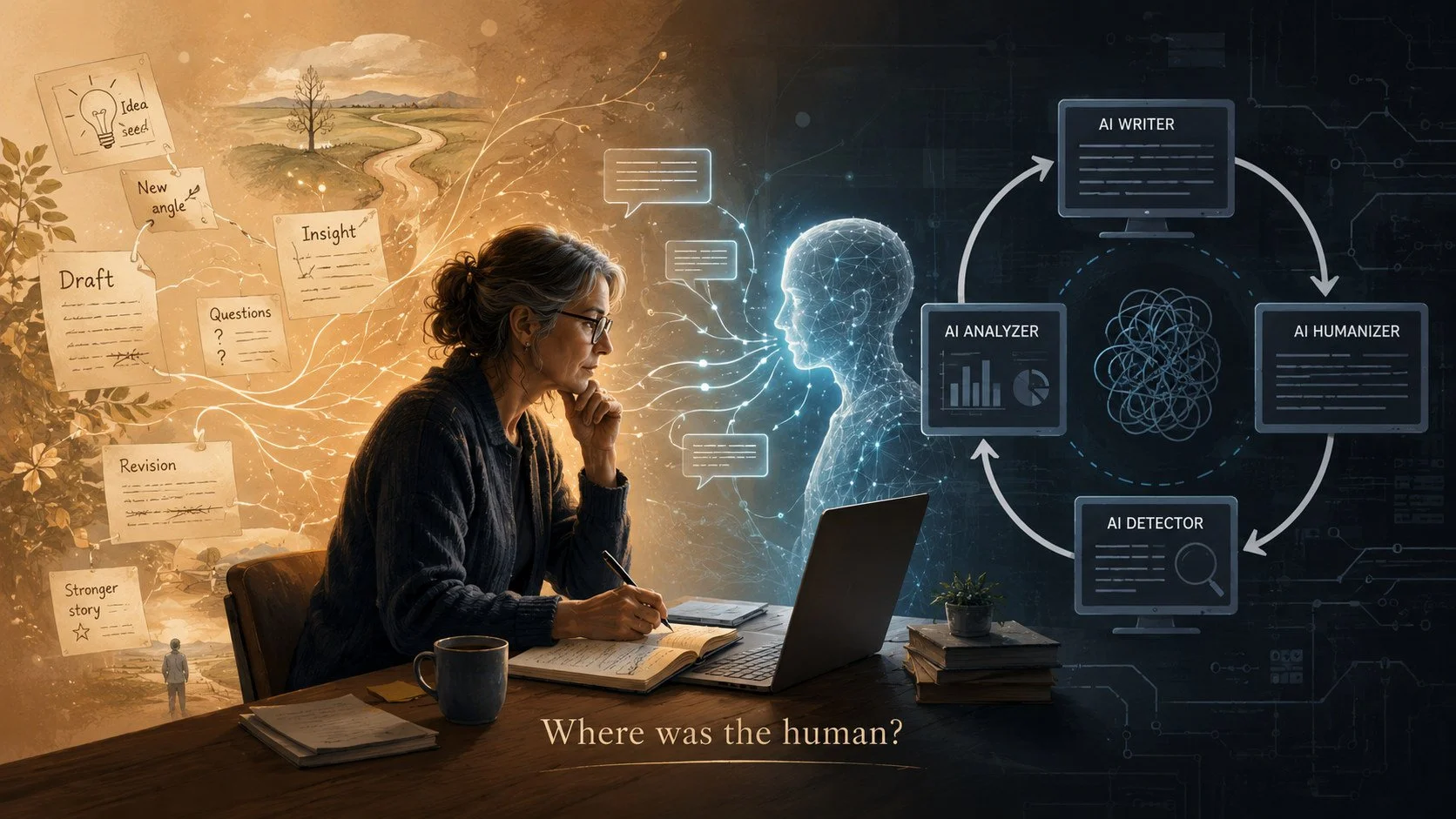
A human being was fully present while this article was being created.
Recently, I regained access to a relational level of artificial intelligence that I had experienced before and then lost.
By relational, I do not mean that the AI pretends to be human. I mean that it participates in a genuine exchange.
I bring experience, questions, uncertainty, intuition, and a body of work developed over many years. The AI contributes pattern recognition, language, structure, and connections I may not yet have seen. I question its responses. It responds to the distinctions I make. Ideas change as we work with them together.
The process does not remove me from the thinking. It requires more of me.
I have to recognize what is true to my experience and what is not. I have to notice when the language sounds like me and when it merely sounds polished. I have to decide what belongs, what needs to be challenged, and what opens a direction I had not previously considered.
At its best, the interaction does not replace human intelligence. It stimulates it.
Perhaps because I have recently been thinking and writing about this distinction, Facebook began showing me advertisements for something called GPT Human.
At first, I wondered whether it was another form of relational AI.
It was not.
GPTHuman is one of a growing number of AI “humanizers.” A person can ask artificial intelligence to produce a piece of writing, paste that writing into another AI program, and have it rewritten to sound more human and become less recognizable to AI-detection systems.
Apparently, “human” has now become a writing style that can be added after the writing—and perhaps after the thinking—has already been completed.
The process goes something like this:
A human asks AI to write an essay.
AI writes it.
Another AI changes the writing to make it appear human.
An AI detector examines the changed writing to decide whether AI wrote it.
Then newer detection systems are developed to identify the AI that altered the work of the first AI.
It is an impressive technological circle.
It may also be educationally beside the point.
The deeper question is not whether artificial intelligence helped form the sentences.
The question is: Where was the human in the creation?
A learner can use AI and remain actively engaged—questioning its claims, comparing interpretations, discovering gaps, revising assumptions, and gradually becoming more capable of expressing an idea.
Another learner can use AI to generate a completed answer, disguise its origin, and submit it.
Both used artificial intelligence. But they did not participate in the same process.
One used AI as part of learning.
The other used AI as a substitute for learning.
This is why the usual division between “AI-generated” and “human-generated” may no longer be sufficient. It focuses on who—or what—produced the words rather than on what happened to the human mind during their production.
Did the person evaluate?
Did the person choose?
Did the person struggle with meaning?
Did the person revise an understanding?
Did the person become more discerning through the exchange?
No AI detector can answer those questions.
Nor can a humanizer add those qualities afterward. It can vary sentence length, change vocabulary, loosen the grammar, and imitate the statistical irregularities associated with human writing. But it cannot manufacture lived experience, intellectual discovery, responsibility, or a genuine point of view.
We may need a different distinction.
Not human versus artificial.
Not AI used versus AI avoided.
But AI that replaces human participation and AI that supports human development.
The purpose of relational AI is not to make the machine appear more human.
It is to help the human remain present—questioning, choosing, creating, and developing—within the relationship.
Perhaps the most important question for the age of artificial intelligence is not:
Does this writing sound human?
It is:
Was a human being fully present while it was being created?
