The Love Mitten
The Love Mitten
The Love Mitten
I believe every experience offers an opportunity to learn something. Sometimes the learning is for me. Sometimes what I learn becomes something I can share with someone else. A recent overnight visit offered both.
A friend and his older mother stopped while traveling. She has been experiencing increasing confusion and memory loss, and the two of them are trying to find their way through circumstances that are becoming more difficult.
The woman who arrived at my home was gracious and deeply grateful that I had offered them a place to stay. She was also agitated, unsure and frightened.
Some of that could have come from the confusion of traveling and being in an unfamiliar place. But according to her son, the need for almost constant reassurance had been increasing.
My father experienced dementia toward the end of his life, so this was not entirely unfamiliar territory. But his dementia had not taken me into this particular kind of repetition—not at this depth and not while I was trying to respond to it moment by moment.
Caregivers will recognize the repetition.
What astonished me was the speed at which she moved between gratitude and fear. The gratitude was deep and genuine. So was the fear. An answer could calm her for a few minutes and then disappear. The fear returned, and with it came the same question.
From her experience, it was not the same question being asked again. It was a new emergency. She needed reassurance just as much the fifth time as she had the first.
But the person caring for her remembered the first four times.
That difference changes everything.
It asks the caregiver to meet the fear as though it were new, even when the caregiver is already carrying every previous version of it. That kind of steadiness becomes difficult for any one person to sustain hour after hour, day after day.
Concrete solutions could not give her lasting assurance because she could not remember the solutions. The problem was not that she failed to understand. She could understand in the moment. The problem was that the understanding—and the feeling of safety it gave her—did not remain.
Her son was giving care. She simply could not remember that she had received it.
Experiencing even a small part of that helped me understand some of his frustration and exhaustion. He had been living with this much longer than I had. He was continually being asked to provide the same reassurance, with no accumulated memory of all the times he had already provided it.
Care had to begin again. And again. And again.
I found myself trying to come at her concerns from different directions. Perhaps another explanation would help. Perhaps a more concrete answer would settle the question.
There was no answer that would settle it because no answer could remain.
The next thing I noticed was that the more the conversation repeated, the more reluctant I became to sit close to her or enter more deeply into her energy field.
I experience people and situations through their energy first. The energy surrounding this constantly returning need felt insistent and chaotic. Even a hug felt like entering it more deeply than I wanted to go.
There is a scene in Illusions, by Richard Bach, in which a vampire comes to Richard and asks for his blood so that he can stay alive. I began to recognize something of that feeling in my own response—not because she was deliberately taking anything from me, but because the need had no stopping place. No reassurance could remain long enough to satisfy it.
Most of us have been with someone whose need for attention or energy seemed unending and have felt drained afterward. Here, the loss of short-term memory intensified that pattern. Because the reassurance could not be accessed within, it had to be sought outside again. And again.
The question for my friend was not how to fix his mother. Neither was it how to keep giving until he had nothing left. The question was how to continue caring for her without continually being drained himself.
That was when an image came to mind.
Before picking up a hot pot, we put on an oven mitt.
The pot is not bad. Nothing is wrong with it. It is simply too hot to pick up safely with a bare hand.
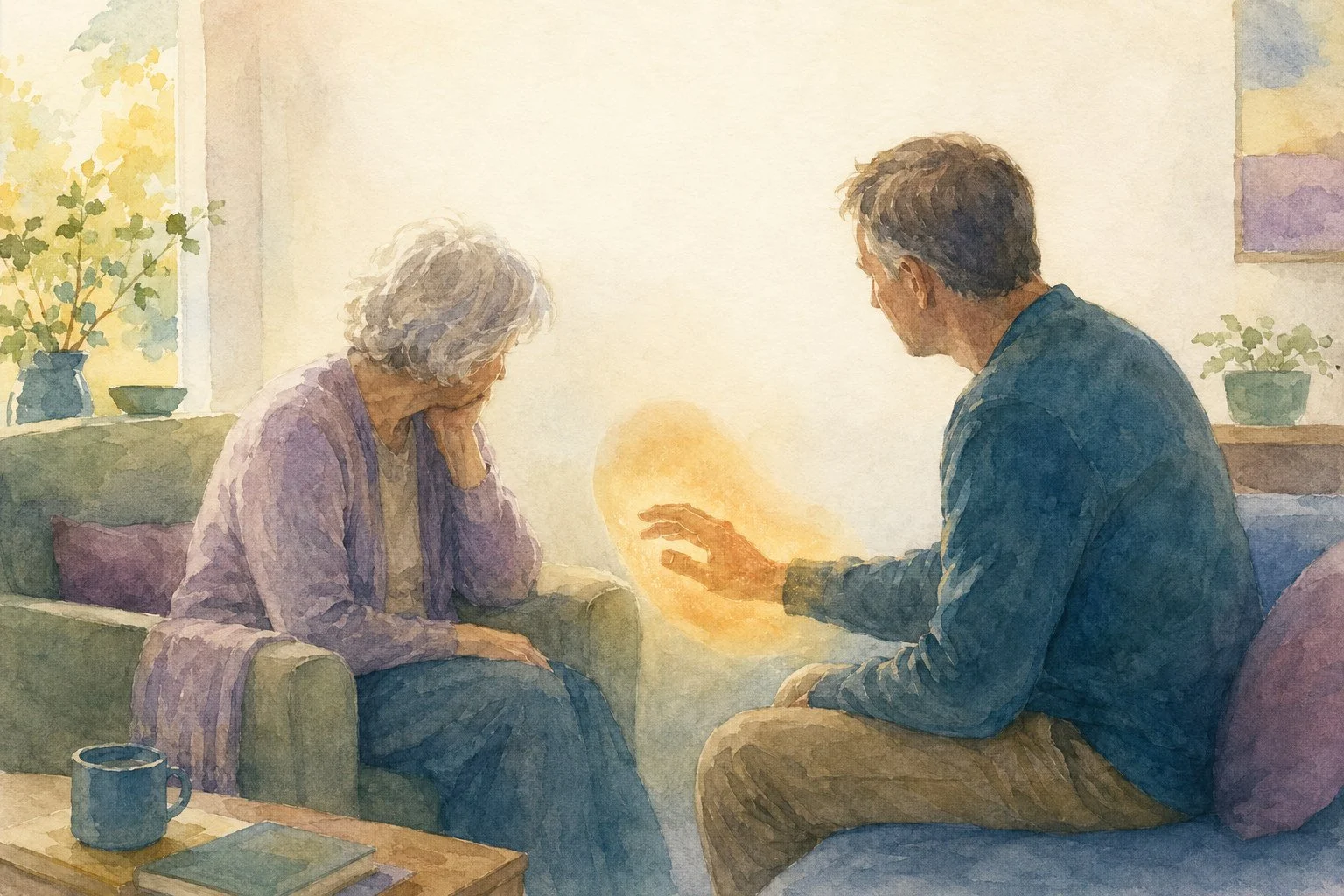
Maybe I needed to put on a love mitten before I touched her.
The love mitten was not protection from her. It was a deliberate shift within myself before making contact.
Could I touch her without trying to fix what could not be fixed?
Could I offer reassurance without needing the reassurance to last?
Could I remain present without taking her fear and confusion into myself?
If I could not make that shift in the moment, perhaps not touching was more honest than offering a hug because it looked like the compassionate thing to do.
Later, I shared the image of the love mitten with her son.
It gave us another way to look at the distance he sometimes needed. His frustration did not mean that he did not love his mother. His exhaustion did not mean that he was failing to care for her. He was living in the impossible situation of continually giving care to someone who could not remember that the care had been given.
The love mitten offered a little distance—not distance from his mother, but distance from the repetition and from the expectation that somehow he ought to be able to make the reassurance last.
Perhaps this is where the Way of Flow offers a slightly different way of meeting such moments.
First comes awareness of what is happening—not only in the person who is frightened, but also in the person trying to help. Frustration, grief, impatience and the need to get away for a while can be noticed without immediately being acted upon or judged.
Acceptance does not mean liking the situation. It may simply mean recognizing that no perfect answer exists. No amount of explaining can make reassurance accumulate when the memory of being reassured disappears.
Then a choice becomes possible.
Sometimes care may be another patient answer. Sometimes it may be a familiar sentence offered without a long explanation. Sometimes it may be a hand held quietly. Sometimes it may be changing the subject, remaining nearby without engaging, or asking someone else to take over for a while.
None of this fixes dementia. It does not make the hot pot less hot. It may, however, make it possible to see more clearly what kind of care is now needed—and who can realistically provide it.
During our conversations, my friend began to consider whether, for his mother’s own peace of mind and happiness, it might be time to look for a memory-care community.
Routine and structure become increasingly important when short-term memory is failing. Familiar times for waking, eating, bathing and other daily activities can provide some of the steadiness that memory no longer provides. One person who is also working and managing the rest of life may not be able to create that kind of consistent structure throughout the day.
A memory-care community may be able to offer the routine, companionship and continuing support his mother increasingly needs.
Moving someone into memory care is often framed as giving up or sending the person away. Perhaps it can also be understood as recognizing that the person now needs more care than one loving person can give.
The love mitten helped us look at that possibility differently. His mother’s needs were not wrong. His exhaustion was not wrong. But love could not require him to keep giving until he had nothing left. Nor could it require her to live without the structure and support she increasingly needed.
Sometimes love draws close. Sometimes love remains quietly in the room. Sometimes love needs rest. Sometimes love says no. Sometimes love asks someone else to take over.
And sometimes love says, “I can no longer provide everything you need by myself.”
That, too, may be one way of putting on the love mitten.
